Showing posts with label review. Show all posts

Tuesday, March 3, 2020

OVERLORD - Blu-ray Review

Overlord 4K (Blu-ray)

Produced by J J Abrams and directed by Julius Avery, Overlord is that kind of WWII-based genre-mashup flick one quite does not expect to be brought out by a studio major like Paramount, let alone a prolific producer of Abrams' stature. Very much reminiscent of the FPS classic Wolfenstein, the very hard-R film's plot follows a quartet of surviving American soldiers - fresh from a gruesomely botched D-day airdrop - making their move to take down a Nazi comms tower stationed on top of a church. Finding an ally in Chloe - a Nazi-hatin' girl from the village where the church is located - and a refuge in her house, they finally begin hatching a plan... until trouble arrives at the doorstep in the form of Captain Wafner, the bad guy with a lustful eye on Chloe. And as the said church is revealed to be housing stuff much more nefarious and sickening than that pesky radio tower, the titular Overlord is born and the film kicks into overdrive, never stopping to catch a breath till the end.


Despite its predictable plot and archetypal characters, Overlord is a blast throughout, as it succeeds in taking its time to build the tension up to the inevitable breaking point while still managing to nail the occasional jolts with jump-scares and graphic moments of hyperviolence. The film also complements the already bonkers plot with fun artistic liberties, chief among them being the middle finger raised against WWII racial segregation, in the form of Pvt Boyce (Jovan Adepo), the naïve black soldier who fights alongside the whites. Game of Thrones breakout Pilou Asbæk effortlessly seethes and snarls as the uber-evil Cap'n Wafner, whereas Wyatt Russell, much like the yesteryear roles by his legendary Dad, plays up his tough guy act as the gruff corporal Ford who believes in playing dirty to get the job done. Mathilde Ollivier makes an impression as Chloe, though she does not get much heroic moments for most of the film. The real stars of the film though, are the VFX and sound departments, with the former going all-out deviant to portray the horrors lurking inside the church and the latter, going for broke from the very start (that plane crash!) and further ratcheting the dread up with the aid of Jed Kurzel's creepy score and perhaps, some of the most terrifying foley work heard till date. Though 110 mins long, the film's edited to keep up with the breakneck nature of the plot and does not feel overlong.


Paramount delivers an excellent presentation of Overlord on its 4k release (which itself contains the 4k UHD disc and the routine 1080p Blu). Shot by Laurie Rose and Fabian Wagner, the film goes for a warm, yet grimdark visual aesthetic for most of the film, complete with oppressive shadows and occasional lens flares (c'mon, you didn't expect that from a JJ flick?), though that doesn't take away anything from the overall picture quality or distract anyone from the bloody, gooey mayhem on display. However, the Dolby Atmos (for both 4k and HD) audio here is an absolute beast that never lets up and keep assaulting from front, back and centre (and even above, per the reviewers equipped with Atmos systems). The lone extra here is an almost-an-hour-long 7-part BTS documentary on the 1080p disc.

Sunday, March 1, 2020

ARMY OF DARKNESS -Blu-ray Review


Sam Raimi's cult horror comedy starts off with a brief recap of events from Evil Dead II, after which our chainsaw-and-shotgun-wielding hero Ash (Bruce Campbell) finds himself trapped in the past and surrounded by medieval knights. They first suspect him to be a foe and sentences him to being consumed by Deadites (a.k.a zombies who know kung-fu) along with a few other suspects. However, armed with his chainsaw, shotg...err... Boomstick, one-liners and (lack of) wits, he becomes the darling of the masses and is bestowed the title of "The Chosen One" who has been brought there to deal with the Deadites. He is tasked with retrieving the "Necronomicon" (Book of the dead) from a Deadite-infested cemetry, in order to have the zombies done for good and to have Ash travel forward in time and back to his normal life... and that's just the first third of the story, folks! 


AOD, from the get-go, is loaded with laughs. Or in Ash's words, AOD is a horror comedy... and horror has already left the town. In any other movie, the aforementioned Deadite-infested cemetry sequence would be fodder for countless scares... but this one is not any other movie, and Raimi and Co. makes the whole scenario a non-stop barrage of Looney Toons-esque gags involving Ash, lots of bones 
and miniature doppelgangers of Ash himself, finally leading to the birth, death and undeath of the film's villain, Evil Ash. And the goofy action-packed finale is testament to the fact that the entire cast and crew - especially the stunt and FX guys - were having the time of their lives with this film. Last but not the least, there's Bruce Campbell who owns the show as Ash 
as well as his evil twin, Evil Ash. Hail to the king, indeed, baby!


Scream Factory has released a truly awesome collector's edition for AOD with three BD-50's, each brimming with content. Disc 1 contains the Theatrical cut with related extras, Disc 2 contains the Director's Cut (which I watched) with related extras and Disc 3 contains the 4k-sourced International cut as well as a TV cut, along with the rest of the extras. The DC looks very good, even though print-related damage can be spotted at places. The DTS-HD MA 5.1 track is a fairly active one, although spatially limited by its Dolby Stereo source.


The extras include a commentary (DC only), a feature-length making-of doc, alternate beginning and ending (for the TC disc only; the DC has these reinstated), another doc on the old-school VFX and quite a few more, which I can't recollect. The cover art is reversible, with one side having the theatrical poster art and the other having the new artwork commissioned by SF (which is used for marketing and release).

Friday, February 28, 2020

ANDROID KUNJAPPAN -Review (Prime)

As his comedic characters in countless films had started becoming increasingly stale and cringe-worthy – thanks to the writers and his own signature elements – one day, a shocker of an announcement appeared on the telly: Suraj Venjaramoodu wins the National Award for the Best Actor. The surprise didn’t last long though, as his big win was quickly dismissed by public – and the Government, which awarded him with the “Best Comedian” award for that year – and written off as a one-off affair. And then came Action Hero Biju. Though Nivin Pauly played the titular cop, it was Suraj’s cameo appearance that won laurels from all around, and since then, the man has been on a winning streak with his selection of roles, both character and comedic - most notable being Thondimuthalum Drikshakshiyum, Kammattippadam and Theevandi. And 2019 had been very eventful for the actor, with him scoring a hattrick of critically acclaimed roles by the end of the year. Here are my thoughts on the first of them, Android Kunjappan Version 5.25, available on Prime.


Predominantly set in a village in Kannur district with occasional detours to Russia, this sci-fi film lies on the less-explored side of the genre – a grounded, humane and plausible look at whether AI has the potential to replace/be a loved one. Suraj plays Bhaskaran, a grumpy, conservative, tech-averse octogenarian who never gets along with anyone, his own son included, and is not above tricking his son into quitting his many hard-earned jobs just to have him by his side all the time. Soubin plays the disillusioned, yet loving son Subramanian alias Chuppan, torn between his duty as a son and his aspiration. The film begins showing the rather strained relationship between the father and son and subtly changes gears once the latter gets employed in a Russian tech firm and brings home the titular Android during a brief vacation, after many a caretaker calls it quits trying hard to deal with the old man. Naturally, Bhaskaran - who doesn't have even a TV - resents the robot at the first sight, but then gradually warms up to it, thanks to its unconditional loyalty and care. His conservative worldview too starts giving way to rationality, thanks to the machine's consistent learning and supply of wisdom. The bot becomes a favorite among the village folks too, and they start calling it Kunjappan. However,
Things start going out of hand as Bhaskaran stops caring about his son - to the point that he declares "Kunjappan" as his own son to Chuppan - and starts pursuing an old flame... on Facebook with a fake ID. 

Though the plot primarily revolves around the father-son-android relationship dynamics, there are many other characters the film touches upon - like Chuppan's Mallu-Jap girlfriend Hitomi (Kendy Zirdo), his hilariously naïve cousin Prasannan (Saiju Kurup) and an eclectic bevy of villagers who keep commenting on the goings-on. However, the film goes a bit off track whenever Bhaskaran is on his online pursuit for Saudamini, his ex-flame, 
and the final moments do feel a bit rushed. But then again, Suraj shines brightest during those very same moments.


Marked only by a few duds like the Hulk-ripoff Athisayan, the sci-fi genre has never been quite a prolific one in Malayalam cinema. It's in this space, that director Ratheesh Poduval has arrived with his debut feature. Along with exploring the key man-bot relationship, the film is also interested in providing sociopolitical commentary, mainly in the form of the robot's innocent, yet witty and sharp statements (the one about Prasannan's "existence" is a riot). It's also heartening that the film's focus is mainly on the emotional aspects and the humor that arises from having a very advanced robot placed in a very rural atmosphere. Coming to the performances, Suraj reigns over the whole show in his career-best role, making even his co-lead Soubin look like an extended cameo. Not even once would one get the feeling that Bhaskaran is actually being played by an actor in his early forties. That said, Soubin is excellent as Subramanian, the intelligent son who is desperate to make his mark and later, the accomplished son, now desperate to bring his dad back to the real world. His numerous emotional breakdowns are relatable and key to the story being told. The Anurachal-based actress Kendy Zirdo is lovable as Hitomi, who stays by Chuppan's side and provides him emotional support throughout. And yes, the film employs sync sound, so all the her Malayalam lines are the ones painstakingly learnt and admirably delivered by herself. The Mr. Bean of Mollywood, Saiju is both funny and endearing as Prasannan, as are the village folks who are always ready with a one-liner for any situation. The lady who plays one of Bhaskaran's caretakers - post Chuppan's departure to Russia - is a hoot, with her addiction to TV serials (which she watches on her phone) and her banter with the old man. And last but not the least, the Android itself is a fascinating character - realized with the aid of animatronics and the short-statured actor Sooraj with VFX only used for the displays - that wins the audience's hearts too, along with Bhaskaran's over the course of the film. The cinematography and editing are deliberately slow-paced, and songs and score gel well with the narrative without sticking out even once.

All said, Android Kunjappan Ver. 5.25 has definitely made an impact in the industry in terms of quality and BO performance, and more importantly, the benchmark has been set for the often dormant sci-fi genre here.

.

Monday, February 24, 2020

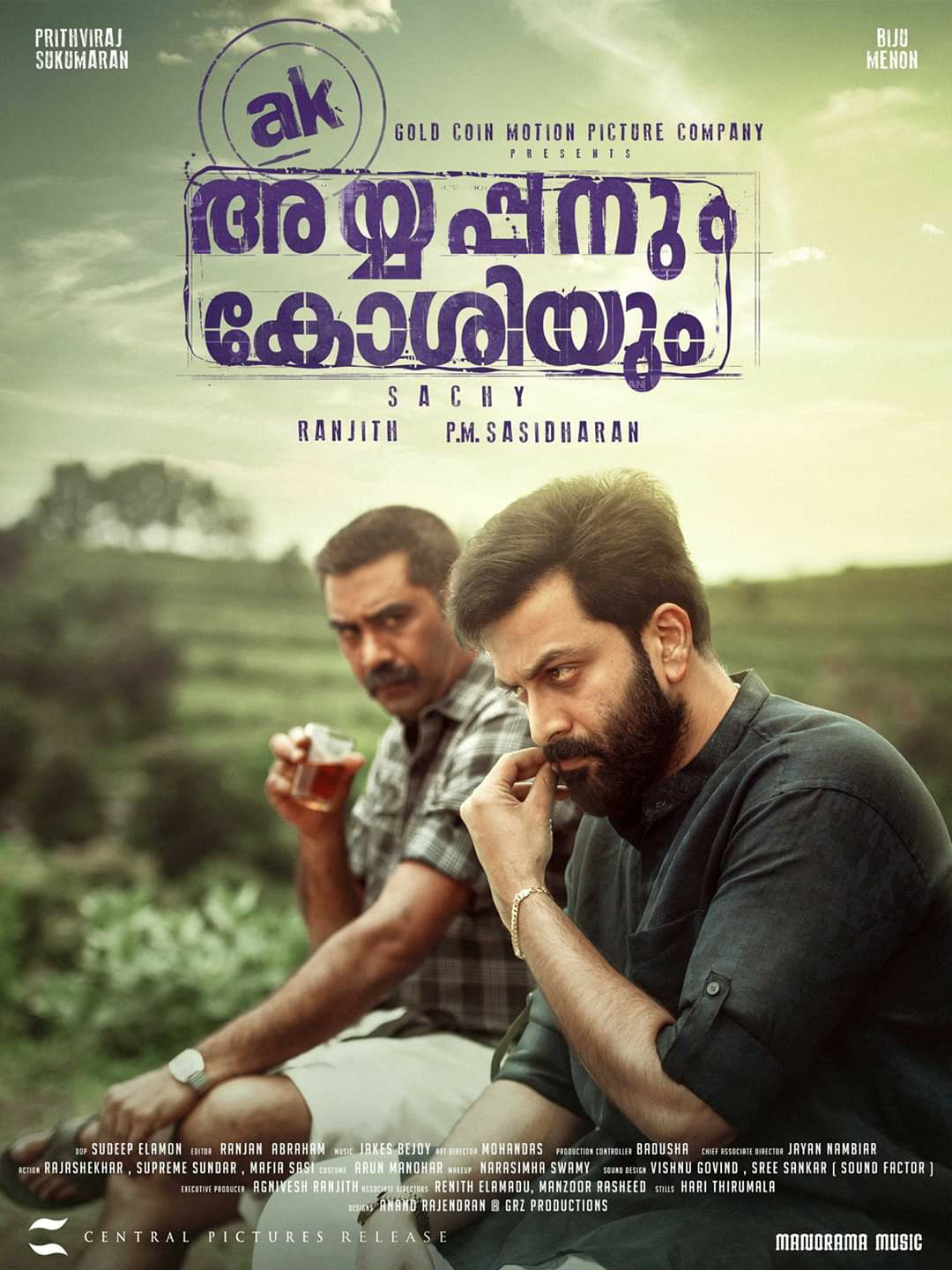
AYYAPPANUM KOSHIYUM - Theatrical Review


Fresh off the success of Driving Licence which he wrote, Sachy reunites with Prithviraj for his sophomore directorial venture AK: Ayyappanum Koshiyum (Ayyappan & Koshy). Also in the lead is Biju Menon, with whom both Sachy and Prithvi had worked with in the former’s debut directorial, the Lakshadweep-set Anarkali. However, unlike Anarkali where the two played friends, AK has them having their sights trained at each other’s throats.

The film begins with a very drunk Koshi Kurian (Prithviraj), getting arrested at Attappadi, a liquor-free zone, en route to Ooty. And the SHO who registers the arrest happens to be SI Ayyappan Nair (Biju Menon), who is due for retirement in another year and having a spotless service record. The former pledges vengeance against the latter, and what gets started as the result of a petty temper tantrum thrown by an entitled a-hole, soon snowballs into a much bigger affair with significant sociopolitical impacts, thanks to the machinations of Kurian John (Director-actor Ranjith, who co-produced the film), the ex-politician Dad of Koshy who considers himself an apex predator with an unquestionable right to devour the less privileged. And yes, apart from being the entitled brat, the retired soldier Koshy also happens to be an overgrown man-child with major daddy issues that prevent him from doing what’s right. Ayyappan, on the other hand, is the dutiful cop who forever remains respectful towards the system, but is forced to wake up the dormant monster within, when push has finally come to shove.

Like Driving Licence, AK too focuses on the two leads and their never-ending attempts to one-up each other. However, what primarily sets the two films poles apart are the motives and the milieu. In DL, the setting is completely urban, and the tussle is nothing more than a battle of bruised egos caused due to communication gap and misunderstanding. On the other hand, AK’s geography is as rural as it gets, and of course, it is Koshy who, purely out of jealousy and spite, sparks the fire. What truly makes AK superior to DL though, is that it is a very politically charged affair and does touch upon quite a few sensitive topics – the choice of location itself, for starters - without shoving those down the audience’s throats. And AK would perhaps be the very first film where the ages-old feudal anti-hero vs the cop cliché gets flipped: for a change, the cop here is heroic and rational (and so are his colleagues), and the anti-hero – essentially, Prithviraj reprising his character from Thanthonni – happens to be downright villainous, that is until certain realizations start dawning upon him.

Even though it’s 170 minutes long, the film whizzes by without a moment of lag, thanks to the engaging performances and the evenly paced editing, courtesy of the veteran Ranjan Abraham. Also crucial to the thrills and the chills is the thumping background score by Jakes Bejoy, who fuses Attappadi’s native tribal beats with sparse studio arrangements. He imbues the same sensibility to his three songs – placed appropriately – in the film.The cinematography by now-three-film-old Sudeep Elamon effortlessly captures the beauty and rawness of the locality as well as the people. The big climactic brawl is as brutally realistic as it should be (but within the limits of ‘U’ rating), considering the fact that this is where the almost 3-hour long build up leads the audience to. And after Anjaam Pathiraa, the Sound Factor guys Sree Shankar and Vishnu Govind go in for the kill with yet another cracker of a Dolby Atmos mix, this time a very relentless and rustic one.


Apart from the two sparring leads, AK also boasts of a bevy of strong supporting players in the cast. Anil Nedumangad, who had already proven his mettle as the despicable baddie in Kammattipaadam, gets to shine here as CI Sathish, Ayyappan’s immediate superior who, while being supportive of Ayyappan, tries his best to contain the very explosive situations arising out of the tiff. And so do the other actors playing Ayyappan’s subordinates, with special mention to the ones who play Jessie and Sujith. Ranjith looks mean as hell playing Kurian John, but his performance comes across as a little bit theatrical, with unwanted emphasis on dramatic pauses in dialogues. While Anna Rajan is okay as Koshy’s docile wife, it is Gauri Nanda who makes quite an impact as Kannamma, Ayyappan’s much younger wife, hailing from a tribal family and rebellious enough to be branded a Maoist. Also making an impression is Ramesh Kottayam as Kumaran, Koshy’s fiercely loyal driver, who secretly loathes the guy’s wayward ways. However, the film could have opted for someone else to portray the DYSP character.

And onto AK themselves: Prithviraj hasn’t shied away from portraying baddies in the past, and here too, he plays what essentially is the villain of the story. However, in what seems to be a brutal deconstruction of his bygone “massy” roles, he manages to make the punchline-spouting Koshy gradually reduce himself into a punchline, by turning him vulnerable, and having his defenses stripped off in the course of the film. On the other hand, Biju Menon deftly underplays Ayyappan, the affable cop eventually made hostile by the circumstances (and Koshy), who prefers brute force to mere words. Majority of the film has the duo facing off each other, contributing to the film's biggest gasps as well as laughs.

.

Sunday, February 23, 2020

TRANCE - Theatrical Review


Let me state the very obvious: Fahadh Faasil is a frickin’ chameleon. And the actor gets his finest hour in the form of Trance, director Anwar Rasheed’s long-gestating project written by debutant Vincent Vadakkan. The film itself deserves kudos for tackling a very controversial subject – as evidenced by CBFC’s now-bypassed mandate to cut around 17 minutes – and is bound to create ripples in the days to come.

Kicking off on a rather low note in Kanyakumari, the film follows Viju Prasad, a motivational trainer struggling to make ends meet, yet persistent in dreaming big. However, after a shocking turn of events, he relocates to Mumbai, where he gets to meet two shady business tycoons. The duo offer him a chance to make it big, and thus the atheistic Viju Prasad becomes Pastor Joshua Carlton, the Miracle Worker capable of healing any ailment - be it fever or cancer - with the power of prayers (as well as Hollywood-grade theatrics). Of course, the “patients” happen to be professionally trained actors, strategically planted in the thousands-strong crowds for the pastor to pick and “heal”. And yes, within the blink of an eye, Pastor JC - pun very much intended, and alluded to within the film -  forms a cult of his own across the globe, amassing billions along the way. But, as with every other shady deal, the faith-healing business too involves the devil himself, and thus begins Viju’s descent into paranoia. 

As seen above, Viju Prasad a.k.a Joshua Carlton is there, front and center, throughout the film, and watching Fahadh perform as this very complex character, one can’t help but be transfixed, lost in…  the trance. The actor gets his own Scarface here - with cocaine replaced by a much deadlier drug: religion - but unlike the consistently LOUUUD Pacino, he opts for a very layered, physical performance that ranges all the way from the subtle to the gallery-pleasing (yet keeping the loudness in check). Quoting one of the film’s characters: “If you call this acting, then this fella deserves the biggest of all the awards.”


And coming to Anwar Rasheed himself: anyone who has watched only his commercial potboilers - Rajamanikyam, Chotta Mumbai, Annan Thambi and of course, Ustad Hotel - would be in for quite a few shocks with this one, as he operates entirely out of his perceived comfort zone here. Unlike those previous films, Trance doesn’t aim to please the crowds with broad comedy, “mass” elements or feel-good drama, instead opting for visual storytelling and a matter-of-fact tone to explore the psyche of its protagonist. Yes, the film clocks in a bit too long at 170 minutes and the post-interval block does briefly test one’s patience, but the way he deftly keeps his target audience engaged for the most part is commendable, especially considering the fact that there was no bound script in place. By the way, those who have watched his shorts - the anthology segments Bridge (from Kerala Café) and Aami (from 5 Sundarikal) - wouldn’t be as surprised, since Trance is indeed a feature-length extension of the storytelling sensibilities used in those. 

Coming to the cast,  Trance boasts of a terrific supporting ensemble, complete with numerous familiar faces making cameo appearances. Apart from Fahadh himself, the only character who is present throughout the film would be Avarachan, the ruthless mentor to Viju Prasad and later, the scheming manager to Pastor JC, and Dileesh Pothen has all the right notes hit for this very puzzling character. Nazriya, a.k.a. Mrs. Fahadh appears post interval as the hard-drinking pothead Esther Lopez, obviously a far cry from the bubbly girls she has portrayed till date. However, the character, despite the actress’ spirited performance, seems shoehorned in, and does serve as a speedbreaker in the narrative when it briefly shifts to her POV. Gautham Menon makes an assured debut in Malayalam as Solomon, the primary antagonist, along with Chemban Vinod who plays Isaac, his partner. Vinayakan, Sreenath Bhasi and Soubin Shahir play memorable characters who, despite their limited presence, significantly impact the narrative at several junctures. 

Stepping away from the director’s chair and back into solely wielding the camera after a long time, cinematographer Amal Neerad holds his horses and initially opts for a muted and earthy tone, only to gradually replace it with his trademark neon-lit style before going all-out psychedelic, just as Pastor JC’s evolution is complete. The various lighting, framing and lensing choices he makes throughout the film are bold and hitherto unseen, at least in Malayalam cinema.  Adding to the richness is Resul Pookutty’s all-encompassing and occasionally disorienting sound design, best experienced in its original Dolby Atmos mix. Jackson Vijayan’s songs mostly serve as part of the score, though ”Jaalame” is used brilliantly as the backdrop for Pastor JC’s stage debut. Sushin Shyam and Jackson Vijayan team up to lend further grandeur to the trance, in the form of their astounding background score. The film’s edited by Praveen Prabhakar in sync with its theme, though the film starts dragging quite a bit post the intermission. Last but not the least, those massive and kinetic sermon sequences deserve special mention, for they are incredibly complex to pull off sans any hitch, and everyone involved - the director, the DP, the sound man, the stunt coordinator, the lead and of course, the appropriately hysterical junior artistes - should take a bow for achieving the impossible.


All said and done, Anwar Rasheed and his team deserve credit for going for an uncompromisingly experimental and satirical take on a gravely serious subject, and for extracting what happens to be the career-best performance from its much-celebrated leading man. Even more kudos for Mr. Rasheed for pouring his own money to bring his passion project to fruition, considering its very polarizing subject and treatment.

.