
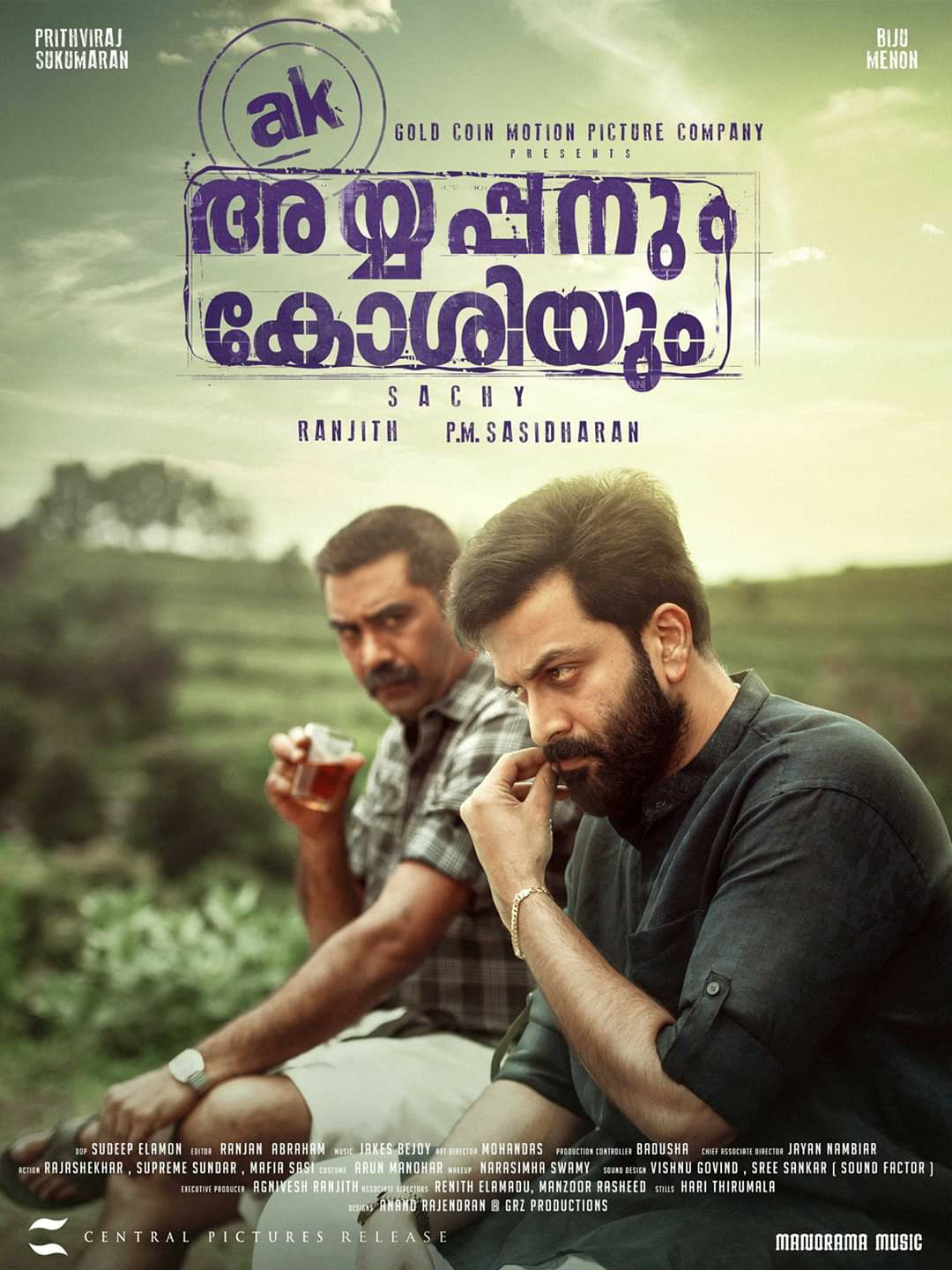
Fresh off the success of Driving Licence which he wrote, Sachy reunites with Prithviraj for his sophomore directorial venture AK: Ayyappanum Koshiyum (Ayyappan & Koshy). Also in the lead is Biju Menon, with whom both Sachy and Prithvi had worked with in the former’s debut directorial, the Lakshadweep-set Anarkali. However, unlike Anarkali where the two played friends, AK has them having their sights trained at each other’s throats.
The film begins with a very drunk Koshi Kurian (Prithviraj), getting arrested at Attappadi, a liquor-free zone, en route to Ooty. And the SHO who registers the arrest happens to be SI Ayyappan Nair (Biju Menon), who is due for retirement in another year and having a spotless service record. The former pledges vengeance against the latter, and what gets started as the result of a petty temper tantrum thrown by an entitled a-hole, soon snowballs into a much bigger affair with significant sociopolitical impacts, thanks to the machinations of Kurian John (Director-actor Ranjith, who co-produced the film), the ex-politician Dad of Koshy who considers himself an apex predator with an unquestionable right to devour the less privileged. And yes, apart from being the entitled brat, the retired soldier Koshy also happens to be an overgrown man-child with major daddy issues that prevent him from doing what’s right. Ayyappan, on the other hand, is the dutiful cop who forever remains respectful towards the system, but is forced to wake up the dormant monster within, when push has finally come to shove.
The film begins with a very drunk Koshi Kurian (Prithviraj), getting arrested at Attappadi, a liquor-free zone, en route to Ooty. And the SHO who registers the arrest happens to be SI Ayyappan Nair (Biju Menon), who is due for retirement in another year and having a spotless service record. The former pledges vengeance against the latter, and what gets started as the result of a petty temper tantrum thrown by an entitled a-hole, soon snowballs into a much bigger affair with significant sociopolitical impacts, thanks to the machinations of Kurian John (Director-actor Ranjith, who co-produced the film), the ex-politician Dad of Koshy who considers himself an apex predator with an unquestionable right to devour the less privileged. And yes, apart from being the entitled brat, the retired soldier Koshy also happens to be an overgrown man-child with major daddy issues that prevent him from doing what’s right. Ayyappan, on the other hand, is the dutiful cop who forever remains respectful towards the system, but is forced to wake up the dormant monster within, when push has finally come to shove.

Like Driving Licence, AK too focuses on the two leads and their never-ending attempts to one-up each other. However, what primarily sets the two films poles apart are the motives and the milieu. In DL, the setting is completely urban, and the tussle is nothing more than a battle of bruised egos caused due to communication gap and misunderstanding. On the other hand, AK’s geography is as rural as it gets, and of course, it is Koshy who, purely out of jealousy and spite, sparks the fire. What truly makes AK superior to DL though, is that it is a very politically charged affair and does touch upon quite a few sensitive topics – the choice of location itself, for starters - without shoving those down the audience’s throats. And AK would perhaps be the very first film where the ages-old feudal anti-hero vs the cop cliché gets flipped: for a change, the cop here is heroic and rational (and so are his colleagues), and the anti-hero – essentially, Prithviraj reprising his character from Thanthonni – happens to be downright villainous, that is until certain realizations start dawning upon him.
Even though it’s 170 minutes long, the film whizzes by without a moment of lag, thanks to the engaging performances and the evenly paced editing, courtesy of the veteran Ranjan Abraham. Also crucial to the thrills and the chills is the thumping background score by Jakes Bejoy, who fuses Attappadi’s native tribal beats with sparse studio arrangements. He imbues the same sensibility to his three songs – placed appropriately – in the film.The cinematography by now-three-film-old Sudeep Elamon effortlessly captures the beauty and rawness of the locality as well as the people. The big climactic brawl is as brutally realistic as it should be (but within the limits of ‘U’ rating), considering the fact that this is where the almost 3-hour long build up leads the audience to. And after Anjaam Pathiraa, the Sound Factor guys Sree Shankar and Vishnu Govind go in for the kill with yet another cracker of a Dolby Atmos mix, this time a very relentless and rustic one.
Apart from the two sparring leads, AK also boasts of a bevy of strong supporting players in the cast. Anil Nedumangad, who had already proven his mettle as the despicable baddie in Kammattipaadam, gets to shine here as CI Sathish, Ayyappan’s immediate superior who, while being supportive of Ayyappan, tries his best to contain the very explosive situations arising out of the tiff. And so do the other actors playing Ayyappan’s subordinates, with special mention to the ones who play Jessie and Sujith. Ranjith looks mean as hell playing Kurian John, but his performance comes across as a little bit theatrical, with unwanted emphasis on dramatic pauses in dialogues. While Anna Rajan is okay as Koshy’s docile wife, it is Gauri Nanda who makes quite an impact as Kannamma, Ayyappan’s much younger wife, hailing from a tribal family and rebellious enough to be branded a Maoist. Also making an impression is Ramesh Kottayam as Kumaran, Koshy’s fiercely loyal driver, who secretly loathes the guy’s wayward ways. However, the film could have opted for someone else to portray the DYSP character.
And onto AK themselves: Prithviraj hasn’t shied away from portraying baddies in the past, and here too, he plays what essentially is the villain of the story. However, in what seems to be a brutal deconstruction of his bygone “massy” roles, he manages to make the punchline-spouting Koshy gradually reduce himself into a punchline, by turning him vulnerable, and having his defenses stripped off in the course of the film. On the other hand, Biju Menon deftly underplays Ayyappan, the affable cop eventually made hostile by the circumstances (and Koshy), who prefers brute force to mere words. Majority of the film has the duo facing off each other, contributing to the film's biggest gasps as well as laughs.
.


